Your cart is currently empty!

Environmental Enrichment (Part 4) Exercise and Play
This is part 4 in our Environmental Enrichment series. Part 1 talked about why it is important for aggressive dogs. Part 2 discussed how to implements it. Part 3 provided 15 examples to get your creative juices going. Here in part 4, we talk about the importance of exercise and play, but also about some of the things to look out for.
Exercise is key! Here’s why:
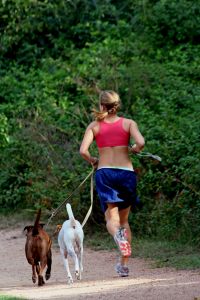
- Research show so much positive impact exercise has in the treatment of mood disorders, mental health, stress, aggression and learning. Your exercised dog will be less stressed, and its positive impacts on both aggression and improvement on learning and memory, is important for behavior modification.
- Aerobic exercise tends to be best on improving well being when it comes to stress.
- Rhythmic exercise also appears to significantly decrease aggression in mistreated children.
- Research shows taking the dog out for a walk creates a stronger bond with your dog.
If you dog tends to get most of its exercise in the back yard simply because you were lead to believe that was good enough, its probably time to start walking your dog, assuming that you can avoid the situations that cause your dog’s aggression
But my dog is aggressive! I can’t walk him outside!
Some dogs more than others get more stressed out going for their walks because around every corner is another dog or another scary person. It makes them on guard the entire time. If you need to figure out what the priorities between the health and mental health benefits of exercise, and avoiding your dog’s stressors, you must avoid your dog’s stressors unless your dog can keep calm. If you don’t, you are just making that part of the brain even better and faster at reacting badly.
Despite how beneficial exercise is, dogs will not whither up and die if they miss a walk – even for a month. They don’t necessarily need daily walking (they do need exercise and mental stimulation), although they will undoubtedly do much better if they can provided they are not becoming anxious in the meantime. So if YOU are stressed walking your dog, it’s okay to take a break. But below are some suggestions that might help with that.
What to do when your dog gets aggressive on walks
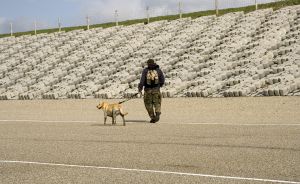
Walk your dog when others are not walking their dogs.
For those of you who have flexible schedules, this is easy. Walking your dog at 10 am on a weekday morning may be much better than in the evening when there are more people around. If you have to, you might try at night or even very earlier in the morning. Just keep in mind that your dog will be more reactive in the dark.
Walk your dog where you are less likely to run into other dogs/people
These might mean a factory parking lot, industrial park, or a shopping mall parking lot if your dog is aggressive towards dogs. We used to play ball with our dogs in outdoor tennis courts and make sure we took a bike chain lock with us so people couldn’t just wander in. Be creative, but be safe.
Invest in a basket muzzle or Gentle Leader Head Halter
Although neither one avoids the aggression from happening (and you SHOULD avoid this at all costs), a basket muzzle
Keep your dog moving
If it is impossible to walk your dog because there is no way to avoid his triggers, look at these ideas:
- Teach your dog to target different objects and send him running around the house or back yard touching these things for the reward of treats.
- Use a “flirt pole
- Teach your dog how to retrieve (not all dogs just do it naturally) and play fetch
- Craete an agility course in your back yard and teach them how to follow your signals through it. You can get agility tunnels, tweeters, jump kits and more.
- Invest in a treadmill
- Teach your dog how to dance with you (you know, you take a step forward, he/she takes a step forward, you turn, he/she turns, etc.). You might be interested in this book: Dancing with Dogs: The Complete How-To and Troubleshooting Guide to Canine Freestyle
or Dancing with Dogs: Easy-to-Learn Techniques and Fun Routines for You and Your Dog
- Play hide and seek in the house, using a combination of sit-stays while you hide, and recalls (calling him or her to you)


Playing
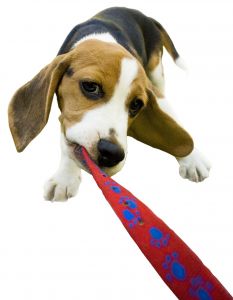
Play is one thing humans and dogs have in common with each other: we continue to play into our adult lives. We are only just starting to understand how important play is.
- Animals that play more often have longer and healthier lives. [i]
- Play and affiliative behavior between humans and dogs – with the absence of any behaviors associated with control or authority of the human part helps to decreases stress.[ii]
- You might be interested in this book: Play Together, Stay Together – Happy and Healthy Play Between People and Dogs

Tips and Cautions:
- Dogs can get over excited and nip or bite. Don’t play roughly with them.
- Contrary to popular belief tug-o-war can be okay in many cases assuming your dog is not possessive over their toys or is likely to mis-read your intentions. Just make sure the humans initiate the play and not the dog
- If they are getting too “revved” (over-excited) up, then before they get revved up, bring them out of the fun to have them sit and relax for a reward before starting up again.
- Make sure you use treats frequently, keeping the spirit of fun and good times alive.
- Make sure you know if your dog is actually enjoying himself. Play is good, but not if it’s making him more anxious.
- Ensure toys and objects are “bite worthy”. In other words, if they chew it, it won’t break, or pieces won’t easily get swallowed
- Rotate toys on a daily basis.
- Use objects that a dog might like to chase, fetch or pounce on.
- Play in aggressive dogs can sometimes be problematic. Dogs with poor impulse control, or who are unable to understand the play rules as they go along may actually become more anxious when they play. This is likely due to confusion in communication and what is needed to maintain fairness and cooperation in play. If your dog doesn’t enjoy it, it’s okay not to play.
Go to Part 1 for an overview on environmental enrichment
Go to Part 2 for an overview on how to implement environmental enrichment
Go to Part 3 for other examples of ways to enrich your dog’s life
This article has been adapted from The Dog Aggression System Every Dog Owner Needs book.
FOOTNOTES
[i] “One research team, led by ethologist Robert Fagen, now professor emeritus at the University of Alaska, spent 15 years sitting in trees in Alaska and Western Canada to observe and document how bears play in the wild. They found that bears who played more often and more successfully throughout adulthood had longer and healthier lives, and thus left more offspring behind.” Orginally retrieved from: http://abcnews.go.com/blogs/technology/2012/02/fun-and-play-are-key-to-survival-for-bears-dogs-humans-birds-and-maybe-even-ants/ June 2012 . Learn more about Robert Fagen and his work on play here.
[ii] Zsuzsánna Horváth, Antal Dóka, Ádám Miklósi, Affiliative and disciplinary behavior of human handlers during play with their dog affects cortisol concentrations in opposite directions, Hormones and Behavior, Volume 54, Issue 1, June 2008, Pages 107-114, ISSN 0018-506X, 10.1016/j.yhbeh.2008.02.002. http://www.sciencedirect.com/science/article/pii/S0018506X08000469
ADVERTISEMENT
The Dog Aggression System Every Dog Owner Needs E-book
Anxious Dog Shirts only available in our shop
Keep people away with our Stand back shirts