Your cart is currently empty!

MANAGING DOG AGGRESSION
Any consultant that claims or even subtly implies that he/she can get your dog “fixed” or “cured” of its aggression is likely trying to sell you on his services because all dogs have the potential to be aggressive.
It is much more realistic to start with the idea that you may not be able to cure his aggression, but with proper treatment and training you may be able to control your dog’s aggressive tendencies, and reduce the behavior. There are a few ways to do this.
Please note that the links that go to Amazon will earn us a small commission if you should decide to buy anything. This helps pay for our hosting and maintenance. But please don’t buy anything you don’t need.
1. Use preventative measures such as basket muzzles (example on Amazon)
2. Avoid the circumstances that trigger your dog (more below). This is probably the safest way to deal with dog aggression, although it does not actually help your dog get better. If your dog has an anxiety problem, avoidance will not address that. Dog-to-dog aggression can be quite challenging to avoid, so look at walking your dog at times when others are less likely to be around. Color coded leashes and harnesses (view on Amazon)
3. Actually treat the dog so he or she can learn to be calmer. This is the most humane if done properly. It improves the relationship you have with your dog and makes everyone – you and your dog – much happier overall. Successfully managing your dogs aggression does depend on what your dog’s problem may be and a good expert can help you with this. Treatment may include a number of strategies from changing elements in your dog’s environment to behavior modification. It may also include medication to help treat the underlying causes if your dog needs it. It may also require a change in your attitudes and expectations. The number one thing that makes a difference is complying with the right treatment program. Learn more about treating dog aggression and 5 treatment methods to avoid.
Three things you can do to manage dog aggression now
Management is not treatment, but you need to keep everyone safe.
1. Avoid triggering your dog’s aggression
Triggers or “stimuli” are the circumstances that cause your dog to behave aggressively. t seems obvious but many people keep exposing their dog to the situation that causes the aggression. Inappropriate behavior is often learned, and the longer it goes on, the more difficult it is to change because neural pathways in the brain get stronger and compete against other behaviroal options.
“The ability of the owner to recognize the potential for the aggressive event and to abort it before it happens cannot be overemphasized. Clients sincerely committed to treatment can learn this, as demonstrated by the high proportion of improved dogs (90% considerable, 75% substantially) seen at the behavior Clinic at VHUP.” [1]
Fear aggression is probably the most successfully treated with a desensitization program according to Dr. Nicolas Dodman, because it is primarily a learned behavior. But even with aggression that has a genetic base, much of the aggression is augmented through learning. This is what behavior modification addresses. However, any dog that is aggressive for any reason can be potential dangerous, even if you think that the aggression is appropriate given the situation. Any opportunity to act on their aggression, will allow your dog to learn fro that experience. This means your dog will become better and faster and more effective and behaving aggressively.
Here is a downloadable safety tip sheet for dogs and toddlers you might be interested. This should be shared with anyone who has young children.
2. Consider a head halter and learn to use it properly
A head halter such as a Gentle Leader
A head halter is not a muzzle. A muzzle can prevent your dog from biting, but will not give you the handling control to deal with lunging. If your dog is dangerous a muzzle is always a good idea to keep people or other animals from getting bitten, however your dog can still cause damage and injury even if he or she is not biting.
Have you vet help you with fitting your dog for Gentle Leader Head Collar
Some people avoid using head halters because their dogs paw at the head halter and try to get it off. However studies have indicated that even though dogs do this their cortisol levels (which is released during the stress response) do not actually rise. This tool is so valuable, it is worth taking the time to get the proper fit and desensitize your dog to wearing one. Here is a link to desensitizing your dog to wearing a muzzle, you can use the same techniques to desensitize your dog to wearing a head halter.
3. Teach your dog to defer to you
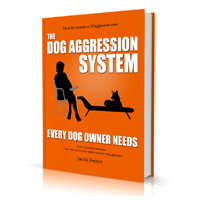
Dodman also writes that the simple NILIF (Nothing in Life is Free, also known as “Working for a living”, or “No free lunch”) can reduce (what was formerly known and misnamed as) dominance aggression within a two month period in about ninety percent of cases. The e-book we recommend on our site (The Dog Aggression System Every Dog Owner Needs) uses the SAW program (Sit, Attend and Wait) which is very similar with a greater emphasis on relaxation and self-control. The benefit of these programs is that it is great for any dog regardless of aggression.
In every case, control is the responsibility of all dog owners and management is always far better than, injuring some one or some thing, taking the life of or giving up your dog. But you must be realistic. Any aggressive dog is potentially a dangerous dog. Some dogs may be pathologically aggressive and resistent to medications. A veterinary behaviorist may help you determine this. But, If you are not willing to do the work to keep your dog safe and others around it safe, seriously consider placing your dog in a home that is able to cope with the challenge of owning your dog and willing to do the work to improve the aggression.
If you can stick with it, you will find that not only is change possible, but it is incredibly rewarding too. When the change becomes second nature you will be glad you stuck it through. As someone once said, “My aggressive dog made me a much better dog owner.”
If you are interested in learning more about treating dog aggression, check out our e-book, The Dog Aggression System Every Dog Owner Needs (print version soon to be on it’s way). It not only describes behavior modification, but talks about other ways to help improve dog aggression.
[1] Clinical Behavioral Medicine for Small Animals, Karen L. Overall, M.A., V.M.D., Ph.D. Diplomate, American College of Veterinary Behavior, Department of Clinical Studies, School of Veterinary Medicine, University of Pennsylvania, Philadelphia. Pennsylvania, Mosby, Inc. 1997
ADVERTISEMENT
Keep people away with our Stand back shirts
Anxious Dog Shirts only available in our shop